

Super admin . 5th Jan, 2026 1:12 PM
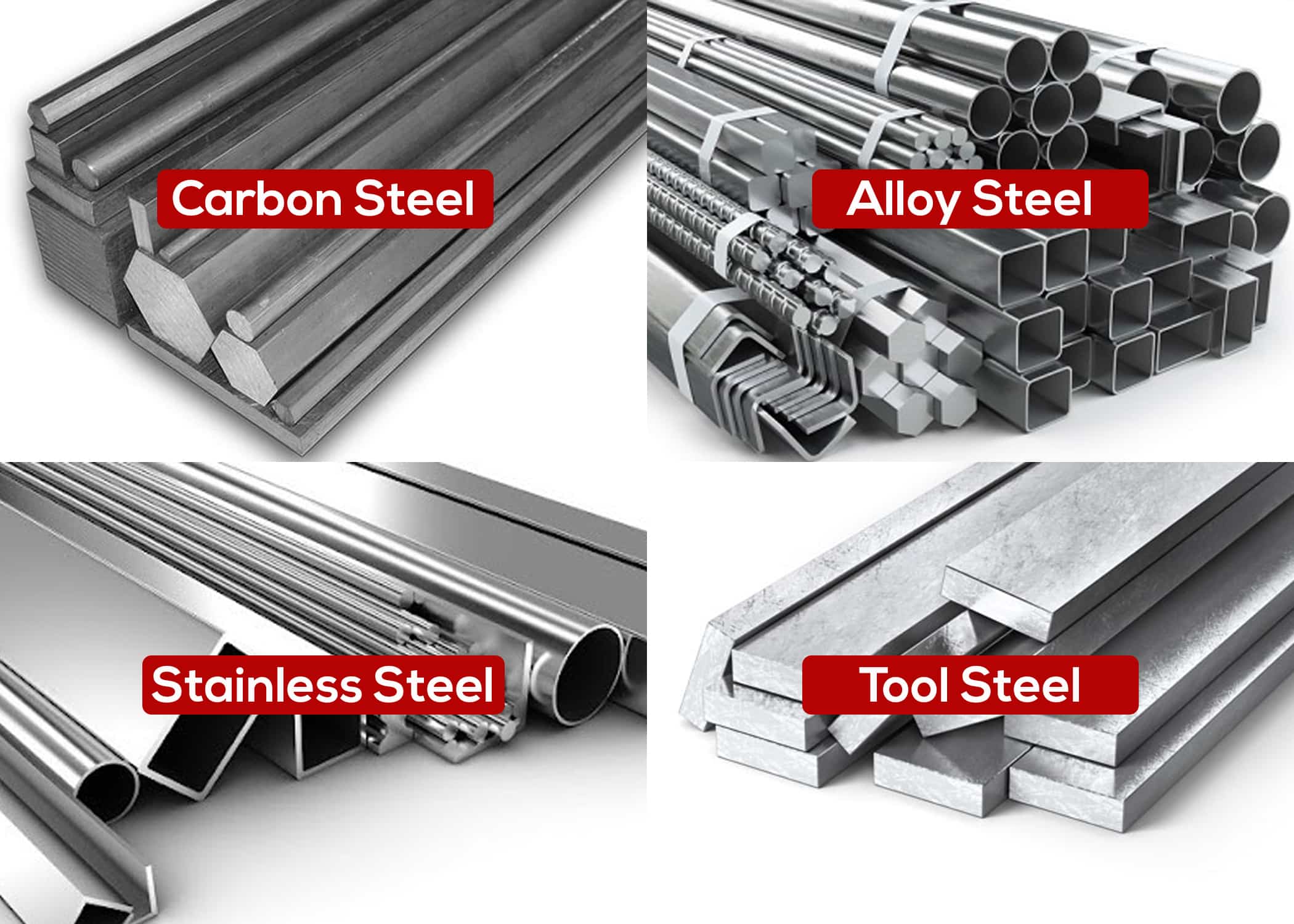
1.1 Low-Carbon Steel (Mild Steel)
Carbon content: 0.05–0.25% C
Examples: ASTM A36, SAE 1020, 1018
·
Tensile strength: 370–550
MPa
·
Yield strength: 200–350
MPa
·
Hardness: 120–180 HB
·
Excellent ductility and toughness
· Very good weldability and machinability
·
Mn: 0.4–1.0%
·
Si: 0.05–0.3%
·
Very low alloy content
· Corrosion resistance: low (requires coating/painting)
1.2 Medium-Carbon Steel
Carbon content: 0.25–0.60% C
Examples: 1045, 1050
·
Tensile strength: 600–800
MPa
·
Yield strength: 400–600
MPa
·
Hardness: 170–250 HB
· Good strength but reduced ductility
·
Mn: 0.6–1.5%
·
Suitable for heat treatment (quenching & tempering)
1.3
High-Carbon Steel Carbon content:
0.60–1.25%
C
Examples: 1095, tool blanks
·
Tensile strength: 800–1200
MPa (after heat treatment)
·
Hardness up to 65 HRC (after quenching)
·
Very high wear resistance
· Low ductility and toughness
·
Mn: 0.3–0.9%
·
High hardenability
·
Used for springs, blades,
high-strength wires
Steels with intentional alloying elements: Cr, Ni, Mo, V, W, B, Mn.
2.1 Low Alloy Steel (2–5% alloying elements)
Examples: 4140, 4340, 40Cr, 35CrMo
Mechanical Properties
·
Tensile strength: 700–1100
MPa
·
Yield strength: 500–900
MPa
·
Excellent fatigue
strength
·
High impact toughness
· Good hardenability
·
Cr (0.5–1.5%) → hardenability & strength
·
Mo (0.1–0.3%) → creep resistance
·
Ni (1–3%) → toughness
· Mn (0.6–1.2%)
Typically stainless steels, tool steels, heat-resistant steels.
Contains ≥10.5% chromium, forming a protective Cr₂O₃ layer.
Composition: Cr 18–20%, Ni 8–12%
·
Tensile strength: 500–750
MPa
·
Yield strength: 200–300
MPa
·
Very high ductility
· Excellent corrosion resistance
·
304: Cr 18–20%, Ni 8–10.5%, C ≤ 0.08%
· 316: Cr 16–18%, Ni 10–14%, Mo 2–3% (improves marine resistance)
Composition: Cr 12–18%, Low C
·
Tensile strength: 400–600
MPa
·
Lower ductility than austenitic grades
· Good formability
·
Cr: 12–18%
· Good oxidation resistance but poor welding at high thickness
Examples: 410, 420, 440A/B/C Hardenable by heat treatment.
·
Tensile strength: 700–1700
MPa
·
High hardness up to 58–65 HRC
· Good wear resistance
·
Cr: 11–17%
· C: up to 1.2%
Used for: knives, turbines, tools.
High hardness, wear resistance, and heat resistance.
|
Type |
Example |
Main Alloy |
|
Water-hardening (W series) |
W1, W2 |
High C |
|
Cold-work (O, A, D series) |
D2 |
High Cr |
|
Hot-work (H series) |
H13 |
Cr-Mo |
|
High-speed steel
(HSS) |
M2, T1 |
W, Mo, V |
Mechanical Properties
·
Hardness: 58–70 HRC
·
Very high wear resistance
· High hot hardness (for HSS)
Typical elements:
·
Cr: 4–12%
·
Mo/W: 5–20%
Similar to cast iron but with lower carbon (0.2–0.6%).
·
Tensile strength: 400–800
MPa
·
High toughness compared to cast iron
· Good fatigue resistance
·
Si: 0.2–0.8%
·
Mn: 0.3–1.0%
· May include Ni, Cr for special grades
Used in buildings, bridges, cranes.
Examples: S235, S275, S355 (European), ASTM A992 (USA)
·
Yield strength:
o S235: 235 MPa
o S355: 355 MPa
·
Tensile strength: 350–550
MPa
· Good weldability and ductility
·
Low C: 0.1–0.2%
·
Mn: 0.5–1.5%
·
Small Si, P, S
About the Institute
Make World Institute of
Petroleum is
a professional QA/QC & NDT training institute dedicated to
developing skilled inspectors for the oil & gas, construction, and
manufacturing industries. Our training focuses on practical knowledge,
industry standards, and inspection techniques required in real projects.
Why Choose Make World
Institute of Petroleum?
·
Industry-oriented QA/QC & NDT training
·
Experienced trainers from field background
·
Practical & hands-on inspection knowledge
·
Career-focused learning approach
Courses Offered
QA/QC • NDT • Welding
Inspection • Oil & Gas Inspection
Contact Us
📍 Location: HIG 04, B Sector,
Sonagiri, opposite to Piplani Petrol Pump, Above Sangam Hotel, Bhopal, 462022
📞 Phone: 9424347045,
0755-493-3347, 9424480384
📧 Email: info@makeworld.in
